Tuesday, August 4, 2015

Time Travel in a Modern World


My second visa run lands me in Kuala Lumpur, the visually striking capital of SE Asia’s first real trade center. Time-worn architecture sits next to colonial Dutch buildings, which in turn give way to the most modern posh highrises, across the street from cramped, low-budget concrete housing. Although most of peninsular Malaysia has been sown with palm plantations, KL is astonishingly green– patches of jungle fill city parks, line high-speed railways and blanket hillsides.

I enter a world of traffic signage and signals, well-maintained roads, ubiquitous coffee shops, megamalls and fast food. The airport contains a mall (or several). KL Sentral, the city’s main transit hub amongst several varieties of train and dozens of bus lines, contains a modern mall– situated beneath the train’s elevated tracks– and a direct connection through to yet another. I drink fancy Starbucks coffee with relish and scan railway tokens and cards with computer chips for the first time in well over a year.

It’s astonishingly comforting to find myself surrounded by a phonetic language for the first time since leaving home. Even though I don’t understand people around me, I can read signs and pronounce words correctly. I pick up phrases without worrying that intonation will change simple food into derogatory curses, a few syllables allowing me to connect more easily with strangers on the street than I have in months.

As I wander into Bazaars throughout my few days in KL, I realize that I understand what people are saying around me. Although I’ve trained martial arts based in the region at home and used Indonesian words and phrases for over a decade, I never expected the languages to be so similar. In a way, it feels oddly like an unexpected visit home.
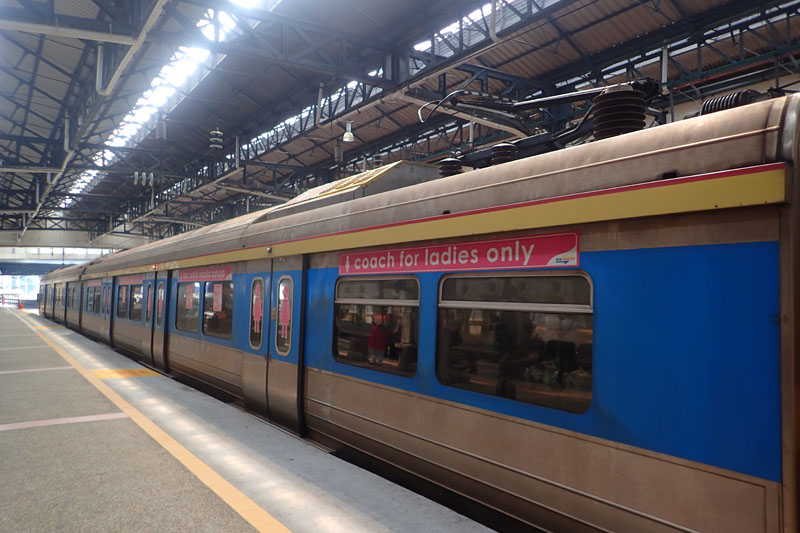
I think Malaysia is also the first predominantly Muslim country I’ve visited. The vast majority of women wear headscarves. Almost every restaurant I enter is Halal certified. I never encounter pork on menus or in street food. Instead of Vietnam’s political propaganda, prayers sound five times daily from loudspeakers located throughout the city. Commuter trains have “Ladies- only” coaches and the more religious men I encounter take care not to touch me.

As a whole, everyone I meet is overwhelmingly kind and eager to point me in the right direction. I think it’s a testament to human character, that such overreaching kindness can hold prevalent in a country rife with racial tension. For a place known worldwide as a cultural mixing pot, tension certainly runs throughout– between Muslims and Christians, ethnic Malaysians and Indians… For the most part, people seem to largely not care that I’m Jewish. It’s somewhat surprising, given that Israelis aren’t even allowed into the country and Judaism has been all but obliterated within Malaysia’s borders. One of my cousin Gideon’s friends mentions stumbling unintentionally into an underground Jewish community of sorts after spotting a menorah in a shop window. Apparently the people she met were guarded at best and surprised she understood the object’s significance.

Terence, a friend of Gideon’s through his life coaching program and former competitive climber, welcomes me into his apartment while I’m in the city. My first evening we drive to the city center and step into the Central Market, a hub of regional handicrafts and souvenir trinkets by day, all but deserted by night. We wander halls laid with 19th-century tile, stopping to dip my feet into a tank of tiny minnows that rush to the task of nibbling off dead skin. We emerge into an alley of historic Dutch buildings, weathered facades housing such modern entities as KFC and Canon.

We stop to sample skewers of lamb, beef and chicken with peanut sauce, and at Gideon’s insistence– Whatsapp has him throwing suggestions to Terence from DC in real time– I manage to swallow a few bites of durian. While jackfruit’s little brother with the texture of spreadable cheese and the taste of rotten sulfur may be one of Gideon’s favorites, I’m more than happy to toss the pit and declare “Been there, done that.”

We duck into Petaling Street, KL’s Chinatown night market, where men roast chestnuts by the barrel and I sample tofu soup and fried noodles under rows upon rows of glowing red lanterns.

Before heading back to Terence’s place we swing into downtown, passing the KL Communications Tower and the city’s twin towers, glass tiers lit and blazing into the night sky above rows of palm trees in front of a full moon.

The next day I wander. I take a train into the middle of the city, crossing the river on a pedestrian skybridge that lands me in the old train station. Still utilized as a commuter station today, the building’s white latticed windows, spiral staircases and towers present a classic convergence of Dutch and Muslim architecture as they stand stark against the gray glass of KL’s surrounding highrises.

I cross through a tunnel and follow a narrow road into KL’s city park, an expanse of jungle dotted with official city attractions. Beyond a butterfly garden I find the edge of the city’s Bird Park, a vast expanse of green draped in netting, proclaimed to be the world’s largest free-flight aviary. At present, a family of macaques has turned the netting into a playground, clambering to the top of its support poles and butt-sliding all the way back down to the road.

Rather than paying the Bird Park’s western tourist entrance fee I eat lunch in the park’s cafe on a balcony overlooking the jungle. Egrets surround me while a massive hornbill hops amongst tree branches, causing water to cascade off leaves onto unsuspecting visitors below. The meal’s only glitch comes when a Russian family enters the restaurant and takes particular offense at some item on the menu… because if watching mega giant tropical birds preen amongst massive trees in the middle of a tropical rainforest in the middle of a megacity isn’t enough to nix the family travel grouch, I don’t know what is.

I spend some time after lunch in an orchid garden before following the road as it loops back down toward the city (Monkey crossing signs, anyone?), arriving at the National Mosque. As I set aside my shoes and the nice little lady helps me into a burka, she asks: “Are you Muslim? You look Muslim.” Although I’ve been told that with a tan I can pass as Mediterranean, or South American, or Middle-Eastern, being assumed Muslim is a wholly new experience for me.

The mosque is simple in its grace, white columns supporting ceilings over open rooms around an open sanctuary designed for capacity. Pillars holding delicate mosaics give way to white walls blanketed in patterned imprints and relatively simple stained-glass windows allow light to enter through the room’s domed roof. A keyhole door at the front of the sanctuary faces Mecca, much as a synagogue’s ark points our way to Jerusalem.

A man standing at the sanctuary’s door with a flip book in his hands draws us into a conversation about Islam. Somehow the well-meaning man manages to turn the conversation into a campaign convincing me that I simply haven’t recognized Muhammed as my true Prophet. Upon realizing that in the space of 20 minutes I’ve gone from lone American tourist to assumed Muslim to Judaism-Islam conversion project, I beg out of the conversation and make my exit.

Friday I wake early, arriving at KL’s southern bus terminal through a convoluted mess of trains. Bersepadu Selatan might as well be an airport terminal– crowds queue by the dozen at ticket counters and hand over ID for verification and monster reader boards announce departure times and locations. Busses board through specified gates throughout the building.

Two hours later I arrive in the historic city of Melaka, one of SE Asia’s first true trade centers. The city’s ancient mashup clusters in winding rows of buildings and alleys and roads, following the river’s curve to encircle its core. Ancient and modern architecture merge as rows of expertly restored oriental facades share street corners and alleys with modgepodges of trendy murals. While the front of my guesthouse throws me several hundred years back in time, the back door opens onto a river walkway blazing with color.

I spend the afternoon exploring aimlessly, ducking into shops as they catch my eye. Just past a mosque I find a textile shop run by a man from Kashmir who moved to Melaka a decade ago. He likes Americans, he tells me, because we love to have conversations and listen. 20 minutes later I’m yet to formulate a polite exit strategy.

Two doors down sits a ceramic studio run by a couple from Japan. Hundreds of spherical lanterns covered in geometric botanical cutouts sit in the forward display room. Further back I a hall opens onto an airy workshop where an older man forms base shapes and his wife carves intricate designs while his children work their own lumps of clay at a side table.

Another ten yards’ walk brings me to a coffee shop I’d expect to find on Hawthorne Boulevard. A bright orange VW van covered in daisies displaying binders of coffee art holds the espresso machine, opposite a wall holding row upon row of empty cans. A barber’s pole points the way to the bathroom from behind scattered tables painted as bulls' eyes. 

I step into an old antiques shop where a Chinese lady admonishes me to watch my purse more closely as we begin a conversation about being in the service industry. We talk about how people of different nationalities act and how travelers truly are ambassadors for their home countries, for better or worse. The conversation draws to a close as she concludes that the reason I’m so polite must be because I’m Jewish and my mother raised me well. I assure her I’ll pass on the compliment.

Before the block ends I find the oldest Chinese temple in Southeast Asia.

I pick up a couple pairs of comfy flip flops and a trucker hat as I cross back through the neighborhood’s party street. (Note to self: head to Malaysia for $3.50 Burton knockoffs… do they even know what Burton is around here??) A short river bridge lands me in the old Dutch portion of town, complete with massive water wheel and an ochre colonial-style church. Constructed entirely of imported brick, it sits behind a courtyard where dozens of rickshaws smothered in stuffed animals and dead-eyed dolls surround flower beds and monuments and a street market selling electronics and Hello Kitty pastries occupies any spare corner.

Just around the corner I find an old motorcycle parked in front of an unassuming tea shop. The  older Chinese shopkeeper with a palpable love for his trade welcomes me, taking a break from his ledgers to make and serve tea, traditional style, half-finished beer set close to his right hand. As we chat he mentions that even though his shop is shop is situated on the edge of Melaka’s tourist district, he’s catered primarily to the local population for the last 20 years.

I return to KL the following day, taking an hour to get lost in a megamall– and eating my first Krispy Kreme since college. That afternoon I connect with Catherine, a KL native who introduces me to an old tea house hidden three stories up a rickety elevator behind an unmarked door in China town. Maintained these days primarily as a tribute to the founders, the shop’s sunset view of the city’s high rises is obscured by thousands of signatures and notes scrawled across ancient window panes.

On the walk to dinner we shortcut through (Catherine tells me) the less-fancy of the city’s ultra-posh megamalls. The thing fits right into my imagination of a presidential hotel, live band in tuxedos playing beneath five floors of swooping accented banisters lined with plants. Monster chandeliers throw soft light on hallways and waiters in a chocolate shop snub their noses at me while serving customers in armchairs that probably cost several months of my salary…. Each. The crystal-strewn walls of the massive Dior shop, lit even after close, strongly concur that this is definitely not my comfort zone.

We eat dinner with Catherine’s roommate, Cornelia, at a middle-eastern restaurant on a downtown rooftop. The two feed off each others’ energy, unwavering zeal and love for life brightening the atmosphere as we bask amongst the wafting smell of hooka, palm trees and pita and gaze up to the KL Tower, lit high above us.

The morning of my last full day in Kuala Lumpur finds me at Batu Caves, a massive natural limestone complex filled with little Hindu shrines (also apparently a massive rock climbing destination. Too bad all my gear was left in Vietnam.). A massive gold statue of the god Murugan  keeps watch forward from the base of a staircase leading to the caves’ entrance. Although climbing 272 stairs isn’t hard, monkeys complicate the ascent. Macaques- the notoriously aggressive and disease-infected bane of my existence, swarm the brightly painted staircase. They chase each other. They grab backpacks. They bare teeth, snarling and screaming. One monkey provides a solid ten minutes’ entertainment when it snatches a pack of newly-bought chopsticks from a plump Chinese lady, climbing atop a pillar to claim its prize. She dances below, offering an upturned sunhat as she asks the monkey to drop her souvenir. When she finally pulls out a candy to offer in trade, the monkey tosses her chopsticks out of reach over the staircase’s far wall before claiming the candy from her hand.

The temples scattered through the caves, lit with dozens of strands of lights, prove somewhat downtrodden. The caves themselves, however, are spectacular. Stalactites cascade from walls hundreds of feet high, dips and swirls spiraling up to tunneled light high above.

Later I meet up with Catherine in Little India, wandering though shops filled with tens of thousands of bangles and aisle upon aisle of sari fabric and eating piles of veggies and rice off of massive banana leaves.


We return to the apartment in the evening, finding our way to the 40th floor rooftop infinity pool and Jacuzzis to watch the sun set over Kuala Lumpur’s skyline one final time.

Saturday, May 30, 2015

The Scary Kind of Fun

The Mission
Stand on top of Polish Pillar, that tall, slender, topsy-turvy spire jutting up from the emerald water far to the north between home and Ha Long Bay.

The Crew
• Luca, an Italian volunteer who speaks five languages fluently and a bit of Arabic on the side. The guy climbs hard and has extensive experience on the wall, both clipping bolts and placing gear. New rock releases Luca’s inner eager puppy, and he’s been on a roll putting up first ascents in the bay since his arrival.

• Liz, a badass volunteer out of Minnesota who’s been traveling SE Asia and extended her stay with us from one month to two after the earthquake nixed her plans to continue into Nepal. Our similar personalities and philosophies on a lot of aspects in life have led to a fantastic partnership, both as roommates and on the wall. The girl is most definitely my new favorite climbing partner.

• Mike and Vince, two Canadian travelers along for the ride.

• Myself.

Amongst us, we compile a modgepodge of gear. We bring Luca’s single rack of finger-to-hand sized cams and my armful of single- and double-length slings. The goods also include three small coils of retired rope, ten well-loved wires of varying sizes and brands and five or six even better-loved cams of random sizes scavenged from the shop’s gear box.

Our basket boat takes us an hour and a half up through Lan Ha Bay, rounding a slender point into the channel separating us from Ha Long Bay. The pillar rises from a small cove just on the channel’s side. Swell rocks the tiny boat as Liz and I gear up, yarding ourselves and our rope onto a tiny sloping ledge to set up a belay, and I begin to climb.

I soon realize that it’s been close to a year since I climbed in the traditional style, placing my own pieces of hardware into the wall to clip into and protect myself as I continue upward. Although the climbing itself is technically fairly easy, it’s also terrifying. I’m well-versed in effective gear placement, but I’m working with unfamiliar pieces on unfamiliar rock. And I know how this rock is formed, dissolving from the inside out, and that it’s not exactly the most intact material in the world. … Did I mention this spire in particular is forecasted to have toppled just about yesterday?

My route wanders into a section of white and tan blocks, comprised of minerals left behind as water seepage evaporates. It’s the exact same stuff that’s broken off in my hands before, leaving me on my butt on a beach in front of several good-humored customers (I don’t think they realized how damn close my head came to a boulder on the way down).

I waffle as I decide whether to place a cam to protect this section of the route, weighing the potential consequences of prying off a block in case of a fall (dropping a boulder on Liz, cutting my rope, dislodging who knows how many more blocks barely held in place in front of me) against the security of having a piece of protection placed just below me as I navigate the upcoming minefield of choss.

I place the piece and pray.

As I move upward, the rock surrounding me rings hollow. Ledges and points and bars, all easy to cling to and stand on, hold to the pillar through crumbling connections. As I cautiously shift my weight across the rock, my right foot swings abruptly into the air. The spur I’d been standing on on bounces down the pillar and zings past Liz into a wash of emerald water below. I take a moment to gather myself, tapping the rock supporting my left foot, and it vibrates beneath me.

I promptly decide that climbing this pile of crumbling crap in a remote bay off Vietnam’s north coast is pretty much as Stupid as it gets. Ego be damned, I’m terrified and it’s time to downclimb.

Then I compare the crumbling rock I’ll have to navigate to retreat against my potential traverse toward solid rock above me and rapidly reverse my decision; at this point, continuing upward is actually the safer decision. A body length up and two steps sideways bring me back onto blessedly sturdy black limestone. Another ten feet up through seeping rock I sling a slender tree, eliminating for good the possibility of hurtling myself into the sea on a misstep.

The rest of the route is relatively straightforward: I pull over a couple of ledges and push through a pocket of brush, disturbing a nest of fire ants in the process. My surroundings seem to drop away as I press forward away from the insects. I collect an ancient quickdraw placed some years earlier in the rock, clipping into the attached wire (booty!) before making a few airy steps up a final corner to build a big, beautiful anchor within the shade of a big, beautiful tree hanging out over the water thirty some-odd meters below. 

Somehow, between four harnesses and two ropes, we get all five of us on top of the pillar at once   (there may have been some impatient free solo action on Luca’s part). We open the summit register to pen in our names– the first additions in three years.
__________

The weight of what we’re doing really falls on me as we prepare to rappel back down to sea. Climbing is such a contentious endeavor in this area– as much as we explain over and over and over again about climbing safety and ropes and bolts and anchors, local police and tourism officials view climbing as Very Dangerous. As evidenced through the regional fallout in boat tourism after the South Korean ferry disaster last year, an accident in one area can have far-reaching ramifications. Were an accident to occur on rope in the Ha Long Bay area, it could very potentially result in a shut down of climbing in the region and come down on Asia Outdoors as the face of outdoor climbing in Vietnam.

I collaborate with Luca to build a bomber rappel anchor and he heads down first. I then freak out a little bit inside when I realize I’m now the most experienced member of the party, tasked with ensuring every person is set up for a safe, long-ass, free-hanging return to the boat below. Convincing a couple of guys I’ve just met who are having the time of their lives that I need them to listen to me, and that rappelling from a giant natural spire is a little different from working on a ropes course, proves a bit of a task. Although I know what I’m doing, I still find myself feeling insecure.

After my feet touch down and we pull ropes and step back onto the boat (the tide has risen a meter or so since we arrived), I take a breath and dive into the bay before heading home.

Last week I led one of the scariest and proudest routes of my life.

Been there, Done that, Never again.

Tuesday, May 19, 2015

Connections

This train of thought began after my friend Dasan died back in January. It’s changed a bit and been added onto since then….

I had a point, not long after arriving on the island, when I began to doubt the way of life I’ve fallen into and followed the past three years. I didn’t question so much my pattern of floating from place to place, or picking up jobs as needed, but rather the types of relationships I build through this way of life. I look home to friends who’ve lived primarily in one place for years at a time, and former classmates, married, having kids. I begin to wonder whether the path I’m on disallows those strong, steady long-term friendships and relationships– those given strength through time as we watch each other grow and lend each support through triumphs and challenges as years pass. I realize that– aside from family– I no longer really have those people in any one place, a circle of friends built into my life story, as it were, to step back into upon my return home. I question whether living without relationships of that strength, depth and duration is right for me.

The people I’m surrounded by on the island here come and go. Although I meet people constantly– the island is a well-known tourist and backpacker destination– I say goodbye just as frequently. Being in the tourism industry can feel like a viscous cycle of loneliness, at times: People pass through in a matter of days. I find myself engaged in the same conversation with each new person: Where are you from, How long have you been traveling, Where are you headed next? The vast majority of talks are absolutely mind-numbing.

A few months into my time here I understand why some coworkers pick and choose who they spend time with, often opting to keep their distance rather than getting to know backpackers on a more-than-superficial level. They’re simply proactively shielding themselves from the pang of saying goodbye and parting with pieces of themselves, over and over and over.

The Asia Outdoors staff fall into another category entirely. We are in essence an island, the only expats living on Cat Ba. We work together, we drink together and we climb together on our days off. We share our dreams with each other, teach each other, get frustrated with each other, cry on each others’ shoulders and tease each other about girls (and boys). Though our time with each other is shorter than it might be at home, our relationships gain intensity far more rapidly.

We have to accept that those relationships we build amongst ourselves are potentially short-lived. My life crosses paths with some coworkers for only a month or two, others for a year or more. The beginning of this month was hard– half of our staff reached the end of their contracts and left within a week of each other.

Thanh is very possibly one of the smartest (and most hyperactive) people I’ve ever met. In the past three years, courtesy of a lot of American TV coupled with a ridiculous outgoing and mischevious personality, the kid taught himself English and took point on managing the company’s ridiculously convoluted finances. He’s well-known for chucking harnesses across the room as he shouts, “No fighting in the office!” On a whim he flings snakes across courtyards, shoots crossbows across the bar and topples head-height cairns meticulously erected on beaches. His favorite phrases include “Don’t be sorry…. just don’t do again.” “Sorry….. Not sorry.” “We all gonna die!” And, "Let's go to the beach!" (With Thanh's Vietnamese accent, "beach" sounds like a very different word.) His high voice (the most common rumor has it he yelled and screamed so much as a kid he wrecked his vocal cords) just amplifies his impish personality. Thanh headed back to Hue, his home city, to go to school for business. He’s going to absolutely kill it.

Mervil is a soft- spoken Filipino with one of the strongest, gentlest spirits I’ve ever met. He has some of the prettiest footwork on the wall that I’ve ever seen and pursues projects with determination and passion. Honest and loyal to a fault, when that kid had something to say, you listened. Sometimes you gained serious insight into gear maintenance. Other times his quiet humor showed through, and you walked away with the valuable knowledge that Filipino slang for a But-Her-Face is "Shrimp–" because you eat the body and tail and chuck the head.

Ben is a happy-go-lucky climber from the UK, always glad to hand out a hug or a lopsided smile. We may or may not have bonded over Game of Thrones episodes leaked and pirated far in advance of official release dates.

I’m going to miss these guys like hell. There’s a good chance that I’ll never see some of them again. Seeing them leave hurts every time, but in the meantime I’ve found a surprisingly strong family in this tiny, constantly shifting community. No matter where we come from and what our experience is upon arrival, we have a common basis in that we’ve all consciously chosen this lifestyle. Despite how we arrived and whether or not we realized what it entailed, we’ve all postponed that security of long-term connections for the uncertainty of who we’ll meet and where we’ll go next; what we’ll learn and how we’ll grow through our time here. That commonality provides an incredibly strong mutual root for all of us.


And, for the time being, I’m ok with that.

Saturday, April 25, 2015

Here Comes the Sun


Weather has finally broken. The sun shines for days at a time, punctuated by occasional electric storms. Lightning breaks Ben Beo Harbor’s black night, exposing pontoons of boats and floating houses in a momentary mockery of washed-out daylight as rain drives into the bay, sheets of water obscuring everything in sight.

The view from the roof is spectacular. We’ve recently moved hotels from a residence on the waterfront of Cat Ba Town to Ben Beo, a short drive across the island’s southeast peninsula. Our new hotel is blessedly mold-free (at least for the present), has wrap-around balconies on every floor and a constant sea breeze. We’ve traded an overabundance of cockroaches for snakes sunning themselves in our courtyard and a miniature black and white cat yowling through the night from a small floating market next to the pier. The building sits so close to the harbor’s crag that a person could literally step off our roof onto the rock. To the north we look out over the island’s floating fishing village; to the south, through an island channel to open sea.

With the season’s change we’ve begun waking to unscheduled island-wide power cuts, arriving at the office to battle our cranky generator. If it turns on business continues as usual, albeit with an abnormally large proportion of staff plugged into the company’s modem. If not, we plunge a few decades back, recording all transactions and logistics by hand in a dimly-lit room without access to email or previous records.

It also currently appears to be the time of year for Lucky Money, as officials drop in to collect what they view as their fair due for not making our lives and logistics more challenging than necessary at various harbors and points of contact in the government. It’s during these times that Western employees tend to find reasons to conduct business from outside of the shop for several hours.

Changing weather brings changes on the bay, as well– jellyfish have surfaced in droves, massive blobs of color dotting the bay’s emerald channels. We’ve begun carrying limes and vinegar with us; the things are absolutely everywhere and surprisingly fast-moving.

With their appearance emerge jellyfish boats. A tall, slender bamboo pole stands at the basket boat’s prow, a spotter standing atop small crossbar fixed half way up. The boat pirouettes through the water as the spotter directs the driver and a third crew member, who scoops absolutely massive jellyfish with a net on a three-meter pole and piles them into the boat behind him. Their catch is staggering.

We’re also in the process of introducing Stand Up Paddleboarding to the company’s repertoire, which has served to highlight spectacularly the challenges of accomplishing goals which would prove so simple in the Western world. Our Vietnamese (Korean?) boards, promised to arrive with leashes and reinforcements for use in the bay, showed up with neither. Since the boards have demonstrated an alarming tendency to pop below recommended pressure, we’re playing a delicate game of trial and error as we determine best methods for safe storage and use. The distributor himself also appears to be denying responsibility for damage done to the boards while they’re in repair– not exactly sure how he figured that one out. When everything works out, however, navigating the bay by SUP is So. Much. Fun.

We’ve been without our usual boat for over a month now while it’s in repair, our interim boat has brought a new crew. One of the crew, Hung, a constantly happy guy in his mid-twenties, has taken it upon himself to introduce us to squid fishing on overnights. After dinner, we load into kayaks and paddle a short distance to where a family has a fine net submerged in the water beneath a glaring light in the otherwise black night. As we watch from the bamboo rails of the family’s fish farm, schools of squid circle beneath the light and a small child practices casting a lure to pass time. Eventually the lights dim and the men raise the golden net from the water, bringing with it dozens of small, translucent squid.

We paddle back to the boat through water glowing turquoise with plankton and eat squid with beer for dessert. Their ink turns our mouths and teeth black, and I manage to appall the crew by following their urging to turn ink into war paint smeared across my face.

As the tides shift (we’re on a 25-hour cycle here, with only one tide per day), DWS (deep water solo) season has also arrived. Getting onto the rock is a challenge in itself, since sea life and waves undercut walls throughout the bay. We chalk up and move to the boat’s prow, rocking in swell and chop, grasping onto specific handholds to pause as Anh Sang backs off to let us climb without the danger of falling from the wall onto the tender boat.

Climbing with nothing but water below me proves both exhilarating and terrifying, especially since I’ve never been fond of heights unless I’m attached to something. Emerald water waits below, however, and after sucking up for a jump or fall from the rock the sea welcomes me in a refreshing embrace before Sang circles the boat back around to retrieve me.


The man’s skills captaining a boat are nothing short of phenomenal (Although apparently he once parked a boat to wait for some climbers and managed to beach it as the tide receded, punching a hole through the bottom in the process). And on a personal level, I plan on getting a whole lot better at cliff jumping over the next few months.