Saturday, April 18, 2015

Visa Run Take 1: Thailand


The trip to Hanoi goes smoothly as can be expected in Vietnam. We’re left to sprawl on the concrete for a good 40 minutes between our first bus and speedboat, and once on the mainland, we take a sideways jaunt to the Hai Phong Hoang Long bus garage for a thirty minute spray-down before continuing to Hanoi.

I find my way to the Old Quarter and check into the Sanctuary, a slim hostel nestled halfway down a cluttered alley, ten minutes’ walk from the district’s busiest streets. The hostel has a clean, simple and individual charm– each room is dedicated to a specific endangered species, with said species painted on the door and additional photos hanging in the rooms.

The area around Ma May itself is one of the busiest streets I’ve ever seen. In the center of the backpacker district, hostels and bars ranging the gamut from grungy to five-star line the street. Trinket shops squeeze into spare crannies, while vendors arrange short plastic stools around low tables to sell street food from sidewalks and corner stalls. Motorbikes parked by the hundreds force pedestrians into the asphalt proper, where tourists and Vietnamese alike swarm amongst the noise of screaming cars and motorbikes. Bicycle rikshaws cycle through, overpriced massage parlors abound and little ladies laden with baskets of banana-filled donut-holes attempt to offload baggies onto me for obscene prices. A side alley yields rows and rows of women selling fresh food from baskets and tubs on the ground­– while one lady hawks spinach and cabbage, the girl next to her takes a meat cleaver to a catfish head, separating the head from the body and yanking out its guts barehanded while a sack of giant frogs squirms on the ground in front of her.
____________________
Stepping into Bangkok hurtles me back into the modern world. A queue forms behind a counter where officials organize taxis and eliminate bargaining from the journey before we pass through a downtown full of abstract high rises, windows gleaming. Cars fill the streets, obeying traffic signals (which function!) in orderly fashion. Without motorbikes’ constant beeping, the streets seem almost silent.

Bamboo Guesthouse, run by a crotchety lady and her gentle husband, is tucked into the far corner of a narrow alley just off the Chao Phraya River and five minutes’ walk from Khao San Road– Bangkok’s epicenter of backpacker debauchery. Small residences and guesthouses connected by a maze of small passages fill the old-style neighborhood.

For the next two days I wander. The city bursts with color– houses’ wrought gates shine purple, green and gold. Temple spires rise into the sky, visible from miles away as brilliant golden paint reflects the sun, inlaid with red, blue, green and mirrored tiles set in geometric and floral patterns. High rises and apartment buildings boast multicolored contemporary accents. Longboats painted in striped green, orange, yellow and red boast garlands dangling from their prows. Dotted throughout neighborhoods I find miniature shrines dedicated to Buddha, tucked into corners or set into giant tree trunks comprised of hundreds of twisting branches, trees and pedestals wrapped in silk scarves. I find monks appear everywhere, bright orange robes contributing to the burst of color around me.

Modern and ancient aspects coexist so naturally here, in a society so stepped in cultural history. Modern government buildings stand next-door to centuries-old temples, transit includes both sky trains and tuk tuks, and while tap water isn’t potable, refill stations pop up every block or so: 1 baht, the equivalent of a nickel, refills a 1.5 liter water bottle.

I find street food everywhere. Wheeled stands shaded by large umbrellas form pods alongside avenues, tuck into allies and cram into markets. Selections are endless: women grill skewered pork and chicken, sell baggies of sliced watermelon and mango and sit behind trays of whole dried fish. Men peddle bicycle carts full of processed sausages and meatballs, ready to hold over a flame with a moment’s notice. Other women set up shop behind a dozen bowls or more of traditional dishes, serving rice and any selection of curries and meats from the midst of giant bubbling pots. At one point I buy a baggie of what fried chicken, soon discovering I’m actually eating deep-fried banana. I haven’t gotten my hands on these treats since living in Ecuador five years ago.

A side street near the palace hosts an amulet market– thousands upon thousands of little metal trinkets amongst dozens of stalls set along the sidewalk. Monks wander the row, bending low over tables, while an older man utilizes a magnifying glass to inspect a rather small piece.  

In a city park filled with flowering trees and manicured lawns, cut through by a small, branching canal,  a man leads a dozen or so ladies in the Cha Cha from a courtyard stage. To my left I hear a wild thrashing and look down to see a monitor lizard, at least two meters long, haul himself up out of the canal and onto the bank, a giant fish clamped in its jaws. Once firmly on the lawn the reptile dumps his catch in front of him, striking repeatedly as it flails before swallowing the thing whole. The fish, three times longer than the lizard’s head, disappears in a minute. Then the lizard slips back into the canal.

In the evening I discover why all the strays have such shiny coats: an older lady approaches two slender cats in a park, dropping fish at their feet and allowing them to rub against her legs before continuing on her way. It’s a welcome change from Vietnam, where the rare feline is a mangy mess– usually they’re just seen as free meat, of the high-end variety.

I find my way to Khao San Road, which puts Ma May to shame. Swanky bars blast western music as tuk tuks and taxis inch through hoards of stumbling tourists. Street vendors hawk food of all sorts (I’m fairly sure the fried scorpions and tarantulas are there primarily for shock factor), and hundreds stalls form a night market, selling overpriced tank tops and Billabong knockoffs. Massage parlors occupy every third or fourth building, drunk tourists sprawled in reclining chairs as Thai women rub their feet. I’ve never seen more tattooed people in my life. Even in Portland. At one point I run into a coworker who’s just left Asia Outdoors, and we watch the best break dancers I’ve ever seen mesmerize the street as their human beatbox maintains a flawlessly inhuman beat for over thirty minutes.

I’ve been informed that the Bangkok’s knock-offs are far better quality than those found in Hanoi, so I head to the markets on my first full day in the city. The river transit system presents organized chaos: crammed long boats speed over the churning water between the river’s twenty thirty or so piers, conductors and watchmen communicating through shrill silver whistles as they approach the dock. Boat and dock collide violently, people swarm on and off, and the boat pulls away within twenty seconds. Colored flags at each boat’s tail designate different lines: although all boats follow the same route, not every line stops at each pier. Express boats vie for space on the pier with cross-river ferries and hoards of slender longboats.

The markets I find hold befuddling mazes of stalls selling flip flops, electronics, clothes, belts, wallets and food vendors. Alleys dead end in shops filled with very Asian-looking stuffed animals, occasionally breaking for giant trees wrapped in dozens of scarves. I find a small shrine set into the base of one where roots reach into the ground, with a happy orange cat clambering amongst the tree’s branches and pillowed fabric where it’s obviously made its home.

My search for clothing is somewhat futile: Although knockoffs may be better quality in Bangkok, they’re still made for tiny Asian people. Half the time vendors insist, “One size! One size! It stretch! It stretch!” …I call bullshit, unless you’re below a size 3. Other ladies simply flap their hands at me: “Nothing for you!”

The district’s wholesale market is something else entirely, stretching in a matrix for miles beneath buildings, intersected only by major streets. Thousands of people swarm narrow aisles, passing stall after stall brimming with trucker hats, coin purses and watches. Aisle after offshoot aisle reveals more bolts of fabric than I’ve ever seen in my life.  An attempted shortcut leads me into a bizarre land of thousands of Hawaiian shirts, garish colors accosting me from every direction.

I watch as the city’s largest flower market comes to life for the evening as women raise umbrellas and tables while men pull trucks to the streetside, ferrying orchids and roses piled high above their heads, fireline-style. Delicate purple, white and green wreaths are created in minutes, presented in ornate stacks or atop miniature shrines. Other stalls bulge outward with bags of marigolds, traditionally used as offerings in temples.

The city’s temples take my breath away. Filled with acres of shining tiled and mirrored mosaics and spires and dotted hundreds of gold-plated of Buddhas and fairies, they embody splendor as none other. Deep red and gold murals line hallways and tell histories from temple walls and ceilings. The Temple of the Reclining Buddha holds a towering statue 160ft long, feet inlaid with mother of pearl as it serenely watches thousands of people who file through. A courtyard hosts an art class of two dozen students, sprawled across the ground as they pencil spires and rooftops to paper.

The Temple of the Emerald Buddha, which is in fact jade, sits next to the palace. Full-length skirts and pants are required (A guard chants a mantra of “No sarongs for men!”), and photos are forbidden. The relatively small figurine sits amidst a room of gold, high upon a shrine and beneath a many-tiered canopy. The adjacent throne room holds the same majestic elegance, shrines and canopies and seats facing neat rows of deeply cushioned, high-backed chairs. Elsewhere, in a museum of weaponry, the palace displays thousands spears, tridents and evolving guns. Around a side passage and away from the crowds I find a small, sheltered garden filled with meticulously pruned bonsai trees, small pools and stone animals.

I treat myself to Thai massage– some combination of interactive, half-assisted yoga and elbows digging into my back and girls walking on me that probably only works because they’re all so tiny. I hate to tell you Vietnam, but I’m pretty sure Thailand has you beat in both street food and in massages.

Getting out of Bangkok proves a bit of an epic in itself. I hail five taxis, all of whom quote me outrageous prices to the rail station and refuse to turn on the meter. An old lady on walking down the street stops to ask where I’m going and tells me the train doesn’t in fact run in the afternoon, since it’s Thai summer holidays. She snags a tuk tuk and quickly agrees on a price, stubbornly insisting I head to the TAT. The locals swear by the place- probably because they’ve never tried to get information out of them. Although they’re theoretically government regulated, I get the impression that only one or two are legitimate– most are simply Thai travel agencies eager to book you on overpriced tours to classic tourist traps. One tells me the station where I catch the train headed to Kanchanaburi is too far away. How far? Forty minutes. One tells me that the last bus has left for Kanchanaburi for the day. When I ask about local busses, she tells me there aren’t any (that’s a lie). One lady hands me a card, instructing me to go away and come back when I’m ready to book a tour. Another lady tells me they leave on the hour (I think this may be a bit optimistic). Finally (Finally!) my driver brings me to a place with a lady who doesn’t offer me organized overpriced tours. Somehow the conversation shifts to Ayutthaya, since I seem to have lost faith in my options to travel northwest this afternoon. Instead, the nice lady tells me to head to the main rail station, gives me concrete departure times, tells me how much a taxi should cost and bids me a good day.

I make my train with five seconds to spare.

Ayutthaya, built amidst the ruins of Thailand’s former capitol, sits on an island amidst three separate rivers’ confluence. I rent a motorbike for the day, giving myself a terrifying combined crash course in city riding and in driving on the left-hand side of the street as I trust my luck and follow street signs written in foreign characters between various ruins and temples. It’s absolutely surreal to ride through a modern city as ruins appear around almost every corner, bleached white with age after the Burmese ransacked any gold and jewels to be had. Little remains to convey how the city once looked: three chedis containing ashes of ancient kings, a few temples and grounds and scattered Buddhas. One sandstone Buddha in particular has disappeared except for the head, wrapped in an ancient tree’s lattice. I watch the sun set from atop an ancient temple just outside town.

I run into the day’s only snarl when I arrive to return my motorbike, walking into an unlocked, unattended shop to find my passport in plain view on the agent’s desk. Because apparently in these parts, leaving to take a shower and letting the lady next door know that some girl will be by to pick it up is totally acceptable. (This seems to be a thing in SE Asia, since the folks at The Sanctuary showed me every passport in their possession when I asked if a friend had checked in.
____________________
Kanchanaburi is, in a word, bizarre. The town mixes a modern center with old-style wooden houses, while hosting a thriving expat population of fat old drunk white men and their Thai wives on Guesthouse row, just off the river– by far the most hazardous position I’ve found myself in as a single white girl this week.

I find the Allied Cemetery, a pristinely maintained grassy expanse shaded my trees crowned with fuscia blossoms, under which lies a mini Arlington. Row upon row of small headstones, flowers planted between each, glint beneath the sun. Among the six thousand graves in the cemetery I find only one Jewish soldier among the rows I wander. I leave a small stone on the grave before continuing on my way.

I duck briefly into the sprawling grounds of a Chinese temple before a dog begins chasing me, barking from behind the monk who’s come to my rescue, before watching the sun set upriver from the rebuilt bridge on the River Kwai. It’s actually slightly underwhelming, aside from swarms of tiny Asian girls posing with selfie sticks and smoothies in their hands, fixing sunglasses and flashing peace signs. Also: apparently the movie managed to get the river’s name wrong (the original River Kwai lies just west), so the waterway was renamed as tourists began arriving in droves.

The next morning I catch a bus to Erawan National Park, where I hike a kilometer and a half upward through the jungle, following the river’s continuous cascade. Insects and water maintain a constant buzzing rush as I climb the falls’ seven official steps, making frequent stops to dunk myself and dodge schools of minnows as they approach to nibble at my feet. The water shifts from a deep turquoise to milky white by the time I arrive at the top of the cascade, pouring over walls covered in mineral-encrusted leaves and twigs. We ignore a sign warning us off the slippery rocks to climb directly through the fall’s path, dodging as monkeys chuck fruit at us, to a final pool below the falls’ towering head, slipping behind the water to swim in a gaping cavern filled with billowing stalactites.


I rent a tent and spend the night in the jungle on the banks of the river, wandering beneath trees full of crimson fruit and watching foreign birds build nests as the sun sets before I head back toward Bangkok and home.

Wednesday, March 25, 2015

Where the Mountains Meet the Sea

One of the aspects I love most about living here is endless possibility and freedom to explore the bay. I’ve come to understand more of the bay’s nuances at this point: I know which passages to avoid at low tide, when water recedes from shelves and connects islands, forcing us to detour. I also know where deep channels wind between shelves, dividing islands to allow passage throughout the day. I know what the water level must be to ride waves through arches or to sneak into specific caves and tunnels, and I know that exploring new tunnels is to be saved for a receding tide–fighting an incoming current as it fills the connecting lagoon can easily trap me inside the black passage.

I’ve come to recognize the majority of islands in the bay by silhouette, as well as major channel markers, specific floating houses, shrines and shipwrecks. I know which coast lines form the mainland, which comprise part of the bay’s intricate peninsula and which stand alone as islands. On days when mist rolls in so thick and fast we can’t see twenty meters in front of us, I’m able to navigate safely, keeping to areas I’ve known for longer and finding my way through the haze back to our boat. 

I’ve gained confidence to choose my own route on days as kayak guide, rather than following a set path. If I want to check out a cave I spotted in the distance, I’ll head that way. If there’s an inlet or region of the bay I haven’t explored yet, I’ll probably paddle that direction next time I’m out. If I feel like returning to the massive tunnel down beyond the harbor, we’ll head in that direction.

I also know that the huge brown jellyfish, often as big as a person, move faster than anyone would expect through the water. The white jellyfish covered in red spots tend to show up individually. On the other hand, if I spot a tiny translucent one with tiny tentacles, there are most likely hundreds more in the area. This may not be the best time to jump off the boat for a swim…

The bay in itself has so many moods. Light changes by the day, even by the minute. Also by night– after dark, bioluminescent plankton rise to the surface and blink neon turquoise when they’re disturbed. When rain pounds down, the drops themselves create enough turbulence that lights flash into existence all across the water. When swell rolls into the main channel, waves crash against rocks in brilliant luminosity.


Three months in, life is looking pretty good.

Friday, March 20, 2015

Fireworks and Rice Wine


The island empties as Tet draws near- the Lunar New Year ranks here at the same level of importance as Christmas or Thanksgiving at home, albeit celebrated for a solid month. Tour operators shut down as locals head home to their families on the mainland. Busses stop running regularly, restaurants close, and chain-style minimarts stock themselves to bursting– there will be no resupply shipments during the holiday.

Red plastic streamers line the town’s streets, holding huge banners proclaiming “Chuc Mung Lam Moi:” Happy New Year! Paper lanterns hang beneath a series of wire arches covering the main pier, which have been strung with lights. The waterfront has been transformed, as well: bright white Christmas lights wrap tree trunks, transitioning to multicolored drapes tangled over branches that end in what can only be described as gigantic fake icicles.

The entire blinding get-up flashes at random intervals, every string of lights independent of the next. That no one’s been pushed into a seizure is nothing short of a miracle.

Tet itself proves a spectacle, on a small-island scale. Anyone left on the island swarms onto the waterfront, where a large (and largely unused) stage has been cleared. I imagine the majority of Ben Beo’s floating fishing village is also present. Along the sidewalks ladies hand out tall bamboo stalks, grasses twisted into hearts and fastened with red ribbon bows. Police (or perhaps army; it’s hard to tell the difference…) have emerged by the dozens for the evening (although the most drastic measure I notice is the confiscation of a water bottle from a kid sitting in the front row, intent on obliterating it into the ground).

Our plan to watch festivities from the Good Bar (located directly above our office, with a perfect view of the stage) gets duped when my coworker Nick runs up to pass on the Minister of Tourism’s invitation to watch the show from VIP seating. When we push through the crowd and arrive in front of the stage, he realizes he hasn’t set aside enough seats. The minister proceeds to kick out a bunch of very official-looking men in suits from their fancy chairs (completely with tables, water bottles and flower bouquets) to make room. Half of us end up sitting straight in the front row.

We fight to stay attentive through the next three hours. A pair of red and yellow Chinese dragons makes way for lengthy speeches interspersed with fairly terrible dancing and singing acts. The martial arts demonstrations prove mesmerizing and hilarious: a four-year-old runs flawless, flowing forms, a group of ten girls presents the most graceful and precise fan form I’ve ever seen, and their master makes an appearance at the end to lean into the points of two massive bamboo spears pressed into his neck, walking away unharmed.

The same can’t be said for the weapons and kicking demonstrations: the poor kid holding (absurdly flimsy) boards for his classmates to break looses his grip on the first, before getting nailed in the nose when his buddy misses the target on the second attempt. The fake guns end up on the wrong side of the stage, so a slender girl “disarms” and throws a kid pointing a finger at her face in front of the entire crowd.

Finally (finally!) we hit midnight. To my coworkers’ vast amusement, I spend the next thirty minutes cowering in the front row every time a ball of light explodes over our heads. (Although we count ourselves lucky that the fireworks are in fact exploding in the sky, since I’m told recent years have seen them misaimed straight into the Good Bar.)

Five minutes after the fireworks conclude, the waterfront is empty once more. We as a group walk down to a restaurant owned by a friend of ours. Truc Lam Man (none of us actually know his name) sets fresh sangria in front of every person before bringing out a who roasted duck (the brain is the best part, he tells us), a plate of mushroom and pork molded by a jelly-like substance, and a huge bowl of rice. We stay long enough for Truc Lam Man to set multiple rounds of rice wine in front of each of us as his wife prays in the New Year before a makeshift shrine erected in front of the restaurant, piled high with offerings as she calls their ancestors back to join them for the holiday.

As most of the company heads home, a few of us hop onto motorbikes and wind our way up off the waterfront, ducking into an alley in the more local area of town to Quang’s house.

Quang can only be described as King of the Mountain. Quang owns the two boats we use for all of our daily trips, as well as several other large junk boats. He organizes our logistics and meals on the daily and charters boats without notice (how on earth he convinced a lady to make a speedboat run after dark during Tet when a guy wandered into the shop with a monkey bite through his thumb is anyone’s guess). He buys motorbikes and “lets us use them for a very large fee,” since it’s illegal for westerners to own vehicles here, and he helps negotiate terms with the batty landlady of the new hotel. (Did I mention that the man speaks perfect English?)

Quang is nothing short of a miracle man.

Tonight, upon entering his house and exchanging lucky money, we find four generations occupying his front room. Quang has gathered his entire family for the holidays. His parents and their siblings fill two couches set along the walls. Quang and his brothers sit in a circle in front of the couches, while their wives, children and grandchildren have squeezed together in another circle near the door around a large silver bowl of nuts and candy.

Quang presses shot after shot of rice wine into our hands, and the room rings as a chorus of voices chant, “Mot, Hai, Ba, Vo!” (“One, Two, Three, In!”) Rice wine makes way for high-quality whiskey as my manager asks Quang’s son – home from school in Europe for the Holiday– whether he has a girlfriend on Cat Ba. Not in Cat Ba, he replies, but he knows a girl in Hai Phong.

Quang cuts in to inform us that Cat Ba is sadly lacking in pretty girls.

I sincerely hope his wife isn’t originally from the island.

The next evening we head to Butterfly Valley for a New Year’s Party with our trekking guide and his family in their small restaurant. Toan, Trinh and Nga live in Lien Minh, the oldest farming village on Cat Ba, nestled into what I believe was once a gargantuan sink hole. Their orchards brim with papayas and oranges, the trees around their restaurant hum with honey bees and a trail cutting through their pasture full of happy cows and buffalo leads to our largest crag– also on their land.

The family lays a feast before us: we sit down to jellyfish salad, breaded and fried oysters, pork, chicken and egg wrapped in lettuce, spring rolls, squid, rice and heaping plates of veggies. Food and toasts make way for karaoke, which makes way for dancing as Toan switches out CDs, and we eventually find ourselves gathered around a blazing bonfire.

Feasts and absurd quantities of rice wine and whiskey carry through the next week. My grandmother would be proud; she never missed a chance to celebrate.

Thursday, February 19, 2015

Primates and Cetaceans

The island has emptied out over the last week as residents return home to the mainland in preparation for Tet- the highly family-oriented, Vietnamese celebration of the Lunar New Year and the nation’s largest holiday.

It also means fewer companies are running trips this week- We’re the only group in sight in our usual morning kayak spot. The absence of locals allows us to explore a bit more than usual—we paddle north through a tunnel to duck into the national park before swinging back around the island risking the ire of local rangers–– they guard the fjord in front of us from a floating ranger station.

They have good reason to be concerned—Ba Trai Dao, the area in northern Lan Ha Bay where we’re kayaking, is home to around 20 Cat Ba Langurs – a species endemic to Cat Ba, of which only 65 or so individuals remain. More importantly, Ba Trai Dao forms the tip of a highly intricate peninsula extending down from the main island by the tiniest, most delicate spit of land, almost totally isolating these family groups from those on the island proper. Although the park’s goal is to promote population growth to the point were the langurs will begin expanding back onto the main island, their slow birth rate (two babies this year were reason to celebrate) and lack of local understanding prove challenging to that endgame.

 And so we swing back, weaving along the shoreline, low tide prompting me to paddle around a point rather than squeaking though a tiny, oyster-lined passage into a yawning cavern dripping with bulbous, swirling tufas. Instead, we pull kayaks up to a sweeping orange beach. A bright patch of jungle shields a small, blue and orange temple, above which an open cave extends thirty meters up into the rock. A short scramble over scattered blocks and copious orange dust to ledges covered in langur poop provide a view back out into the bay over the karst islands we’ve just kayaked around.  

I decide on a whim to paddle across our small channel and explore the coastline of an island still fairly new to me. Low tide has brought the water’s surface to within a half meter of the coral shelves extending from the island’s beach, and we chase schools of fish over the edge into deeper water. As we move along the rock one of my customers asks about larger fish in the area. “Nope,” I answer, “Not really any big fish left in the bay… oh hey, there’s a huge-ass DEAD fish, though!” I pull a sharp right to where the dark gray lump floats, and catch sight of its oddly-shaped head as I pull closer. “Hey, I didn’t know we had parrot fish in the bay!” Another two strokes and I’ve managed to discern skin and a fluked tail. “…..awwww shit, that is most definitely NOT a fish.”

(This slight episode hereafter will be referred to as “Gavi’s Guiding Brilliance, Exhibition A.”)

We circle our kayaks around a tiny porpoise, less than a meter long and very very dead. Honestly, it resembles one of the embryos you’d see in a bottle of alcohol in a science museum, titled “the progression of a fetal whale.” Smooth skin still carries evenly-spaced vertical indentations, perhaps from its mother’s ribs; blood leaks from a tiny blow hole.

I give it a ride to a nearby beach on the back of my kayak before spending the next hour playing cat and mouse with phone service in the bay, notifying our Western conservationist and our Vietnamese head ranger of its location. Later in the evening, Neahga informs me that the Finless Porpoise, almost certainly stillborn the night before, is the first he's seen in Lan Ha Bay.

The next day, four of us charter a basket boat to head up into Ha Long Bay on our day off. Chu Bien, our primary basket boat driver and the oldest member of our crew, mans the rudder with his ever-present gentle smile. Islands appear shrouded in morning mist ahead of us as we move forward over the bay’s perfectly glassy surface, sun beginning to glint through the clouds as we near a smaller channel dividing the cluster of landforms.

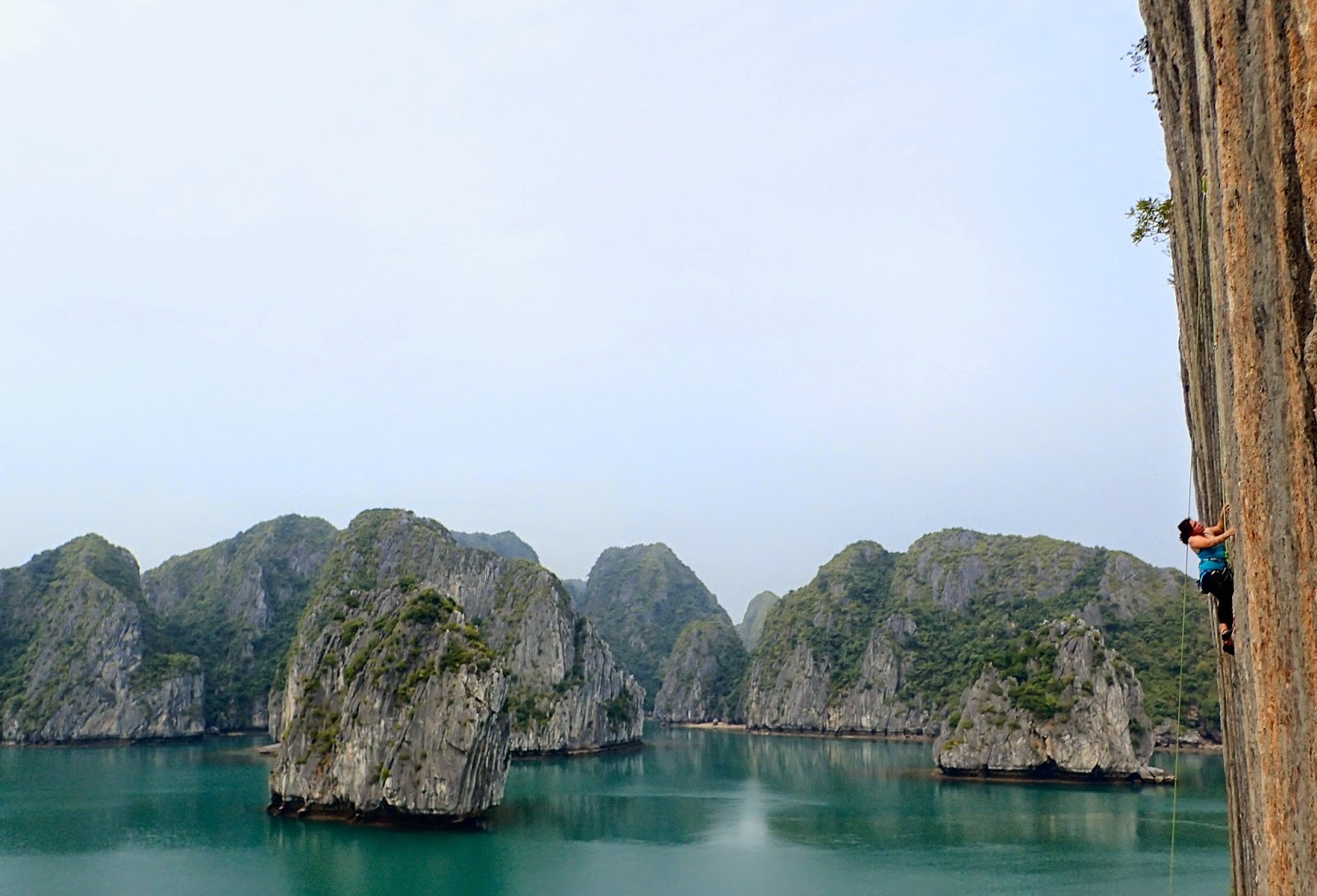
Our destination, The Face, soars proudly from the channel’s center. Massive blocks spill haphazardly into the water, heaped at the base of its diamond wall. The cliff itself is the most beautiful piece of rock I’ve ever seen, curving gradually into a gentle overhang forty meters in the sky. Minerals coating the wall have left an impression of deep yellows, oranges and black caught mid-flow, strewn with delicate pockets, tufas, flowing rods and the occasional mineral crystal.

We’re completely isolated from traffic, surrounded by islands in our little channel as Chu Bien anchors and curls up to nap while he waits for us. We spend the day on the most technically challenging and inspiring sport route I’ve ever been climbed, testing delicate holds on rarely-climbed rock and ducking loose chunks (this is why we wear helmets, kids!) as occasional pieces break and tumble into the sea below. In the evening, we curl up to sleep on the boards hiding the basket boat’s engine as chase the sun home to Cat Ba over a windless sea.

Wednesday, February 11, 2015

Settling In

I’ve been on Cat Ba for a little over a month now. The overpowering in-your-face effect of the island’s larger aspects (the pho, the constant– and fairly terrible– karaoke, the swarming motorbikes) have become less overwhelming, allowing me to notice smaller nuances of the culture I’ve set myself into.

I know now to allow three days for my laundry to dry, strung on lines on the roof in our perpetually humid environment. I structure grocery runs to the mini mart (and lunch breaks) around the Vietnamese version of Siesta, from noon-2:30. Stalls at the market will let me barter; streetside shops carry set prices. The 8:00 am siren no longer brings tornados to mind, instead signaling the ferry’s arrival from Hai Phong and our own call to work. The green on our rickety pool table moves slightly every time a hand adjusts when lining up a shot, using either the sticky cue or the crooked cue to wage war against our perpetually chalked and battered cue ball. Alongside free pool the bar above Asia Outdoors sells laughing gas, sheesha and weed over the counter.

I’ve begun to carry a clearer notion of what I most definitely cannot get my hands on here–– proper hair ties don’t exist. Neither do flash drives compatible with Macs (I’m pretty sure I own the only apple computer on Cat Ba), duct tape or lip balm. Unless I’m keen on slathering myself with whitening agent, I won’t be buying moisturizer or sunscreen any time soon.

I’m also catching onto customs that tend to be different here- subtle things that vary from culture to culture, that I begin to understand and integrate with tips from friends and coworkers.

We eat family-style on the boat; that I understood and have appreciated from the start. We lay dishes loaded with food in the middle of our circle, piling our preference onto rice in our little individual bowls. At some point Ross, a coworker, mentioned a hierarchy amongst our crew and staff (however laxly the boat crew themselves hold to it). The next time we ate on the bay I noticed clearly that at the head of the circle sits Chu Bien, our basket boat driver and oldest member. Ages range downward toward the foot of the circle, where the youngest person sits and dishes rice as needed. We wait until the oldest person has begun to eat before helping ourselves.
_______________

When in the city for lunch I often wander toward the market, avoiding sidewalks (with their crowds and incessant restaurant hawkers) for the relatively open waterfront boulevard. A family of black dogs with stubby legs rules this territory: I imagine there’s some shepherd somewhere in their ancestry, but at the moment they roam and sprawl across the road together as a pack of overly happy sausage dogs. The island contains an abnormally large percentage of short-legged dogs. I’m told that, in the west, sausage dogs were originally bred to go down badger holes. I feel like their prominence on the island is more a result of an obscene amount of inbreeding.

Somehow I don’t expect to see them around much longer; I’m told that the island’s population of dogs decreases to almost nothing through the course of Tet- our upcoming Vietnamese holidays.

Motorbikes honk as I continue down the street, alerting me to their presence. We play a silly form of dance as we weave between each other, avoiding larger cars and busses carrying tourists toward the western harbor. Younger men roast clams over coals over buckets on the curb. Beside them guys on motorbikes offer rides or rentals from bays of scooters and far jankier manual machines. As I near the market I begin passing streetside shops: some hawk cell phones, rice cookers, puffy jackets or metal fittings. Rarely does a shop sell more than one or two categories of items; shopping requires a jaunt into several different stalls. Mini Marts, carrying snacks, toiletries and liquor, prove the exception.

The market in itself contains an entirely different culture, much of which I’m still woefully unfamiliar. Aisles criss-cross through the area within a giant, low- ceilinged covered building. At the back entrance, just off the street, dozens of ladies sell fruit piled high on tarps in front of them through the morning. By evening, this area transforms into a street food plaza of sorts. Tables and low stools sit in front of ladies selling soup, noodles, greens and various forms of meat, added in without regards to separating flesh from bone.

The back entrance leads into housewares territory: stalls brim with dishes, chopsticks, blankets and rice cookers. One or two ladies run sewing shops while others try to charge me obscene prices for weak, rusted needles. Further in, stalls sell crackers, pringles and cookies. A turn toward the far end of the market brings me into restaurants serving phó and other unfamiliar dishes. Encountering large groups of men downing bottle after bottle of rice whiskey or vodka over lunch proves fairly common– the midday meal is that in which most drinking is taken part.

If not serving food, the population shuts down for a solid two hours during midday. Further through the market women doze behind tables laden with greens, noodles and individual veggies, providing opportunities to walk through and buy separate ingredients to piece meals together. Other tables left unattended hold pig legs, belly and other body parts, while a man in the next aisle takes a meat cleaver to a roast dog (identified by the skin' distinctive smoky-scorched texture).

I bypass the dog and a room of fresh fish and bins swarming with seafood, stopping in front of a lady sitting behind a pile of springrolls. 20,000VND later I continue on with a baggie of four spring rolls a side of fish sauce. Toward the market’s front entrance, past several rows of rice whiskey sold out of vessels full of dead lizards and sea stars (good for your health), I find the fruit ladies. They man stalls full of mangos, dragonfruit, lychee, melon, bananas, some giant form of Asian pear and tiny Vietnamese apples (that have a tendency to go bad within a couple days). They also happen to be some of the cattiest ladies I’ve ever met, and bring into glaring light the difference between customer loyalty in the West and that in Vietnam: whereas we tend to give people discounts in order to court customer loyalty, these ladies will wait until customer loyalty is firmly established before beginning to offer reasonable prices. Now that I’ve returned to the same lady several times in a row she’s begun charging me fairly, although as I walk away I draw sullen glares from the other women flanking the aisle.


I walk back toward the office having traded 70,000 VND ($3.50) for 15 bananas, a mango, springrolls and fish sauce. A bench full of bean bags, an open-air balcony and a janky pool table are waiting for me.