When we arrive in Santa Cruz on Monday, I determine that Dramamine is a Very Good Idea for my next two-hour-plus voyage on the high seas. In the harbor we pass a fancy National Geographic ship, complete with magazine cover outline on the bow. Apparently the TED conference is taking place in the Galápagos this year, so lots of celebrities have paid bank to come sit on a boat on the equator and listen to well-known scientists and announce new marine reserves while we grace the island. Santa Cruz is
busy. Stepping off a boat into Puerto Ayora, a town of around 18,000, after spending two and a half months in Puerto Baquerizo Moreno (Pop 5,000) is somewhat overwhelming. I feel assaulted by civilization. There are four piers. There’s a supermarket. There is a street lined with pharmacies, brand stores (ok, just one, but still.), classy souvenir shops, and people and cars everywhere. It’s noisy, it’s smelly, and there are an absurd number of streetlights. The island itself, apart from the town, is also vastly different from San Cristóbal. Its shores are laced with narrow channels–old lava tunnels turned shark resting waters and shaded swimming alcoves. The sun is more intense– many of us apply sunscreen for the first time in weeks. And the weather comes with more variation: although during daylight hours the sun sears the earth, most evenings bring a cool breeze. I am able to don jeans in comfort for the first time since Quito. Over the course of the afternoon we settle into the hostel, sleep off the boat ride, explore the town, and– allow me to revert to my hormonal 21-year-old self for a moment– only one entirely unimpressed male member of the group comes to dinner reporting that not only did he manage to locate Lonesome George: he watched the sadly unreproductive tortoise from across the enclosure from Leonardo DiCaprio. I can’t lie: we’re jealous.

Tuesday we pile into speedboats that take us to a little island just out of the harbor called la Loberia where we snorkel in the waves with a huge number of new species of new fish, including brilliant immature giant damselfish hiding among the rocks, glossy black adorned with bright turquoise spots. A huge male lobo relaxes as the waves crash over us, carrying us perilously close to each other before the human component makes a point of scrambling away. We then head back into the bay along the cliffs, passing just beneath preening blue-footed boobies and lava gulls, to the mouth of a channel where we again jump out to snorkel. Here we find a school of baby parrotfish (complete with surrounding cloud of feces), marine iguanas and white-tipped reef sharks. While the majority of the two-meter sharks pass under us and into the channel (restricted access only), one decides to circle a few times before coming to rest in a sandy patch a few meters below, baring its teeth as we approach through a downright evil thermocline to take photos. Our last disembarkment of the morning leads us up a winding rocky path until, after 20 minutes, we find ourselves peering over the top of a set of 45’ cliffs into another channel, filled with deep, cool, clear water... And so we jump.

Wednesday we are reminded that, despite all appearances, we’re still in class. The morning is spent at the Charles Darwin Research Center, in the first air-conditioned room we’ve encountered since arriving in the islands, watching researchers’ presentations over fisheries, climate change, conservation, and turtles, and other aspects of the biography, geology, oceanography, and ecology of the islands. In the afternoon we tour the research center. We pass mockingbirds perched on candelabra cacti known to be over 70 years old, having lost all the spines from their now toughened brown trunks. We watch young tortoises– five or six inches across and recently out of the hatcheries– sleep, slowly lumber along paths, and make carnage of greens strewn among their masses. We walk through an enclosure where giant male tortoises spend their days; unfortunately the mid-afternoon sun shines down and they have all decided to take refuge in the vines that ring their home. We therefore view of five giant tortoise butts and one who decides to grumpily show his face to the world. Continuing up the path, we come to an overlook into an enclosure containing a remarkably lonely and dejected- looking Lonesome George, complete with legs splayed out and neck sprawled across the ground, head hidden behind a rock. Dear Lonesome George, methinks you need some new lady friends. Next we come to the land iguanas. Unlike the black marine iguanas, these are fat and colorful: the three species contain a mix of red, orange, yellow, and gray. While two simply bask in the sun the third decided to make its way toward us, stopping on a log to fill its stomach from the overhanging shrubbery. After dinner we discover that the lights shining down into the water off the end of one of the piers reveal baby black-tip sharks, golden cow-nosed rays, spotted eagle rays, sting rays, half-beaks, lobos and a strange carp-like fish, all of whom we watch for hours on end. We also discovered that distributing one room key between five people is one of the most idiotic ideas ever.

Thursday we embark on a voyage to Floreana, about a two hour ride from Puerto Ayora. Upon waking up I determine that Dramamine is in fact a Very Bad Idea; moderate nausea beats the inability to think or stay awake no matter what the circumstances. Upon arriving at the dock in the island’s only town (population 100), we clamber onto the roof of a truck and traverse a 20-minute dirt road into the highlands. From here, a trail leads us through the forest into a large enclosure where tortoises roam, fighting over food, stumping across the paths or resting in the shade. Our path then winds up past the only natural spring in the island, from which we fill our water bottles. We then ascend through a maze of narrow, steep-walled passages through the lava rock, at which point we found ourselves on a grassy lookout from which we can view the countryside and all the way back down to shore. Our trail back passes by caves in which settlers first slept, complete with stone fireplace and chimney carved into the walls, as well as an eerily Easter Island-esque face peering out from the hillside. As we begin walking down the road before the trucks pick us up, monarch butterflies flutter past and alight on the green shrubbery around us.
In the afternoon we snorkel the coastline of Champion Island, just off of Floreana, covered in candelabra cacti and home to boobies, frigatebirds, herons, lobos, iguanas, tropicbirds and lava gulls– all of which were visible from the water. Upon jumping off the boat, we discovered that the island’s walls dropped quickly into the deep blue abyss. Below, a marbled ray glided beneath us and out of sight. Giant schools of surgeonfish teemed along the upper portions of the rocks. Parrotfish, as well as any number of species I didn’t recognize, made their way around the wall with the current. Lobos– a yearling and a large male– played in a small cove. A triggerfish forages along a shallow shelf. All around us, the sun’s rays shone down into the deep. Once back aboard the boat we pass by one last island, sticking up like the top of an ice cream cone from the sea. Composed entirely of grass-blanketed lava flows, it teems with mating boobies and frigatebirds, some with crimson pouches inflated, others paired and settled side-by-side. As we make our way back to Santa Cruz I ride on top of the boat with a friend, basking in the sun as the spray occasionally crashes over us. Out of sight of land, we pass through a pod of perhaps 30 bottlenose dolphins. As we shriek in awe and delight like kindergarteners they emerge everywhere in sight, skimming the waves and leaping high above the water before crashing down to disappear once again.

Friday is a solo day. In the morning I take some time to watch the fishermen bring in the previous days’ catch. This takes place on a cement outcropping and counter built into the sidewalk next to the road that runs along the waterfront where the fishermen tie their boats in a line, hoist their fish up onto the tile floor, hose them out, toss them onto the counter, weigh them and carve them into the desired cut before laying them out for display and sale. The process is followed (with interest and fascination) by tourists and (with unwavering diligence and greed) by pelicans, herons, gulls, marine iguanas and lobos. Pelicans perch throughout the mangroves bordering the platform, eagerly awaiting the next boat’s arrival. They mass on the tiles next to fish to be sprayed down as fisherman work, ferociously attacking every scrap of skin tossed their direction… provided the lobos haven’t snapped it up first. They squeeze onto the counter, seizing entrails set aside as fish are prepared. Marine iguanas claw their way into fish’s open caverns, ripping apart shreds of flesh and gulping them down. Interesting, since their natural diet consists of green and red algae. As for the lobos, there are usually two of them: always the same ones, according to the fisherman. They are puppy dogs. They plop down and stare woefully at the fish sitting on the tiles, waiting for action. They rear up in classic lobo pose, nuzzling at fishermens’ legs, waiting for scraps to be thrown their way. And if they’re feeling ambitious, they stand up on their hind legs, supported by the counter wall, peering over the top at the workers filleting fish, intently watching the process and appearing for all intents and purposes to be human shoppers. The space is filled with noise: lobos chase each other, barking madly. Gulls scream. Fisherman shoo pelicans off their catch, resulting in a myriad of flapping wings and exclamations of vexation as said wings whack humans over the head. And of course, everyone mobs the scraps. One pelican is missing half of the top of its bill, another the bottom of its bill and most of its pouch: results of fights with lobos over food.

In the afternoon, I meet up with a friend from the USFQ Quito campus. Raquel, by coincidence, is also from Ptown and also feels the urge to escape from her group for the day. The two of us and three others from Raquel’s group hop into the back of a taxi, soon arriving at a tortoise reserve in the highlands. After fitting rubber boots, we spend the next half hour tromping through the forest, finding happy reptiles half-submerged in ponds, caked with mud, and plodding through the undergrowth. One, a young 60 years old, finds particular interest in our group, raising himself off the ground and beeline for us before an overexcited girl scares him into dropping with a huff and retracting his head as she poses for a photo. From the tortoise reserve, we drive down a dirt road past cows carrying Cattle egrets to park next to a deep, dark pit which happens to be the entrance to a lava tube. We make our way down into the cave, in which there are lights strung every 10 meters or so along the walls. No utter black of the Ape Caves here. Raquel and I are soon bypassed by a group of chatty gringos and mange to lose our taxi driver-turned-guide and the rest of our posse. We now have the cave entirely to ourselves and take advantage of the situation by exploring, taking photos, gossiping and squeezing into nooks and crannies, eventually emerging to face an exceptionally exasperated driver waiting for us. But we’re only in the Galápagos once, right? Might as well take our time while we’re here.

Saturday afternoon I find my way down a 2-mile path shaded by a mix of trees and cacti, slurping passion fruit and dodging lava lizards, to Tortuga Bay. Tortuga Bay is quite possibly the most beautiful beach I have ever seen. Its 400 meters of unblemished silky white sand stretch into the distance, giving softly under your my feet as I make my way toward the bright turquoise water. The waves, despite their color, remind me of home: they roll ceaselessly as far as I can see, piling up over each other to form layers upon layers of surf that snake up around my feet. Baby black-tipped reef sharks swim through the shallow surf, dorsal and tail fins sticking up like flags out of the foam. A patch of mangroves mark the end of the beach. Iguanas have congregated under their branches: around 20 individuals have hauled themselves on top of each other into a giant black breathing, spitting mass. Through the mangroves we find a hidden cove. Water laps gently against the sandy shore, the shallow bottom extending far into the calm water. If not for water hovering around 85° and waves crashing into the far end the cove, reminding me that it is indeed connected to the sea, swimming out into the water would be exactly the same as making my way into a cool, clear mountain lake. As I return along the bay the setting sun reflects off the sheen of water receding from the damp sand at my feet, accentuating crab tracks where a certain crustacean has recently skittered around a series of rocks.

Isabela is
tranquil. It’s what I pictured when I imagined island life before arriving in the Galápagos: sandy streets crisscross through Puerto Villamil, a town of 2,500 residents directly bordering a beach similar to that of Tortuga Bay, except that the sand is tan and the waves slightly less dramatic. Much of the land is barren. Cacti grow directly from lava flows that stretch toward greener mountains rising dramatically into the clouds. Goodbye Cascades, Hello isolation on spits of land in the middle of the Pacific: I now describe 1,400 m as dramatic. The sun sets over the hills every evening, coloring the sky dark peach behind clouds’ gray silhouettes over the turquoise water as iguanas clamber out of the sea to congregate on frozen pitch black lava flows. Isabela is also big; if I turn away from the beach and try really hard, I can almost make myself believe I’m on a continent.

Unfortunately I am entirely nonfunctional for the duration of my first day in Isabela (courtesy of explosive diarrhea, splitting migraines, and a 104 degree fever), and so we skip to Monday. Monday we cram into an open-sided vehicle filled with plastic-padded benches that defy the notion of leg room and drive through barren lava fields dotted with cacti up into the moist slopes of Sierra Negra. From here we hike up a rutted, muddy, shrub-lined path to the top of the volcano, make our way to a small patch of rocks at the edge of a cliff, and find ourselves peering down over the rim of an enormous 7x12 kilometer caldera filled with sprawling new black, inky lava flows. The far edge of the caldera is hidden by clouds so fine you can’t tell where the edges are. Apparently we’re lucky: it’s usually raining. When we turn around we can see all the way up to the north end of the island, as well as east to Fernandina. From here we follow the rim of the caldera (encountering native plants, introduced plants, plants endemic to the Galapagos, and plants endemic to Volcán Sierra Negra) and turn down the outer slope where, after a time, the thick, moist green vegetation gives way to vast, barren expanses of lava rocks and flows crisscrossed by hollow tubes of once-viscous rock. At the edge of one of the flows, we stick our hands into a hole extending eight inches or so underground and find the earth radiating heat: the air is around 20° hotter than the land’s surface. The flows, the tunnels and the rocks scattered across them are astounding. From far away the fields appear brown-red, the landscape cut through by a swath of a newer dull black pahoehoe flow. Upon closer inspection, we find ourselves among a rainbow captured and frozen into rock. Intense blue, purple, red, orange, yellow, and shiny iridescent black that throws off silvery blue and white all twist and meld together in flowing, oozing, dripping rock frozen in time. In places, we cross fields of the less friendly aa lava, blown through with thousands of air bubbles and covered with sharp edges. Here the rocks form a half-mile wide jigsaw puzzle, each piece a different vibrant color in a clashing landscape. This area of Sierra Negra is known as Volcán Chico: it is a place where magma forced its way through fissures under high pressure until it reached the surface, rocketing into the air before it came crashing down to form a series of classic cones, output spilling down the slopes. The cones themselves are not large: from 10 to 60’ across. When we inch up to the edges, we peer down into pits cast into darkness by their walls, graced by rainbow mounds of lava rock. In the bottom, where rainwater sinks into the earth and sunlight reaches for fleeting minutes of the day, lush patches of dark green ferns thrive. After snacking among the spatter cones, we begin the 5-mile hike back to the waiting vehicles.

Tuesday morning we snorkel in a shallow inlet formed by lava flows that have spilled into the sea. Scanning the water for anything interesting, we find swimming dinosaurs. When we race over, we discover that they are in fact marine iguanas returning to land after trips into the bay to forage on algae. They follow a narrow underwater channel formed by a collapsed lava tube, heads held just above water and legs plastered against themselves as their entire bodies and tails move back and forth, propelling them forward with startling speed. I find a tiny, bright, iridescent blue fish hiding among the rocks before I proceed into slightly deeper waters. A hawksbill turtle appears just under me, drifting nonchalantly with the waves. I turn crazy excited; until this point, I’ve only encountered green turtles. The markings on his flippers are more pronounced, the plates on his shell less clearly defined. True to his name, his hooked upper beak-like jaw extends down in front of its face. Since he doesn’t care that the waves bring us within inches, we drift together for a while. On my way back to the boat, a yellow moray eel peers out at me from within the cracks of a rock covered in red and white christmas tree worms. Back in the boats, we head across the bay to a rocky outcropping where a colony of Galápagos penguins have congregated. I am again reminded why penguins are pretty much my favorite birds ever: They stand on the rocks, wings tucked over tuxedo-black backs, staring straight ahead as if nothing in the world has ever bothered them. Every so often, they lift their wings wide and shake their rumps, fluffy tails flapping side to side. And occasionally, they throw their heads back and trumpet toward the sky as loud as physically possible for a foot-tall sack of feathers and bones. And, of course, they plunk themselves in the water, paddling out, diving down, and shooting through the currents in search of fish. Our last stop of the morning is on a spit of land called Tintoreras. We walk between piles of marine iguanas and peer into a channel in which an exceptionally large white-tipped reef shark has taken it upon itself to pace back and forth below us. In the afternoon, a group of us venture to Concha de Perla, a cove adjacent to where we snorkeled in the morning. We swim among the roots of the mangroves, which are blanketed in millions of tiny, transparent krill. Plankton has turned the upper two feet of the water into a deep, murky red and the rest of the water shimmers eerily like a giant, endless thermocline. And the water is freezing, so we cut it relatively short.
Wednesday morning we return to the highlands once more. We follow a path through a rainforest unique to Isabela’s southern slopes, arriving at the mouth of a lava cave. Our guide hands out casi-nonfunctional flashlights: one per three people. Too bad no one told us where we’d be going: I have my favorite mini-mag stashed in my bag at the hotel. Somehow, five of us manage to lose the rest of the group while taking photos, ending up with a single pathetic light with which to guess which direction we’re supposed to proceed in the pitch black– yep, there are two. We yell at the top of our lungs: the sound is dull, quickly canceled, and we receive no response. Fantastic. We follow a set of steps that curls around a corner and find ourselves face-to-face with the end of the tunnel and the rest of our waiting group, an entire 10 meters away. We spend the rest of the morning at a farm that, in conjunction with PNG, raises tortoises in a large enclosure until they reach adulthood. After gorging ourselves on fresh fruit we run around like maniacs on a soccer field, playing camp games under the equatorial sun.
In the afternoon, we return to Concha de Perla to snorkel once again. This time I swim toward the mangroves that separate the inlet from where the iguanas swam yesterday and discover collapsed, submerged lava tunnels everywhere, camouflaged by mangroves anchored to the dividing rock. Their vertical walls are layered: the top few feet of the black rock is swathed with the remains of oyster shells, cemented where their previous inhabitants died. The middle layer hosts feathery organisms that shoot out from the walls and sway in the current while the bottom portion is covered in algae. The channel’s floor is blanketed in light tan sand, tinted slightly green by the clear turquoise water. Where the tunnel remains intact, turquoise and tan fade into a yawning black opening. I swim around the mangroves to find the other end 30 m or so away, crossing paths with a giant dark moray eel who darts his way up the slope, jabbing its head into nooks and crannies before taking refuge in a suitable hideout. Before jumping out of the water I also find a hawksbill turtle and a stingray foraging along the bottom, throwing up wide halos of sand as it searches for food.
Thursday we head back to Santa Cruz to board the Guantanamera, our home for the next three nights. The boat has a dining area, an upper deck with an awning and five lounge chairs overlooking the bow, which is large enough for several people to congregate comfortably around the anchor. My cabin is tiny: two narrow stacked beds are accompanied by perhaps 12 square feet of floor space, part of which is occupied by a bedside cabinet. We do, however, have an adjacent bathroom with sink, shower, and manual-flush toilet all crammed almost on top of each other.

Friday I wake up to Rabida Island. Bright and early at 7:45 we take an inflatable boat to shore, where a beach the color of dark rust gives way to dark cliffs concealed by shrubs and candelabra cacti. After an uneventful walk, snorkel along the cliffs where they drop 20 m or so into the clear water. Shallow rocks near the beach are lined with vivid violet anemones dappled with green and orange. Giant cornet fish idle above shallow shelves. A huge male lobo shoots past. When I free dive to the seafloor, I find stingrays resting among beds of garden eels. As we venture away from the cliffs, the sun’s rays penetrate into the deep blue, illuminating schools of sergeant majors, surgeonfish, and endless masses of creole fish. Green sea turtles drift past with the current… and then the sharks show up. Enormous black-tipped reef sharks swim pass below myself and a friend, so in classic 21-year-old-marine-bio-student fashion, we give chase. We free dive among them until we find ourselves on the receiving end of karma: suddenly circled closely by no less than five sharks, the smallest of which is larger than myself. Since being devoured isn't on our agenda we beat a quick retreat back to the cliffs, where we look down to discover a massive moray eel progressing along the shelf as it searches for a suitable hideout directly above a resting white-tipped reef shark.
After lunch, we travel along the coast of Santiago Island. Santiago is vast, covered in flat, barren lava flows that have poured around uplifts created as a result of the Galápagos spreading center. These errant chunks of displaced sea floor protrude in sharp angles from the frozen black currents, their sedimentary layers angling upward in blatant statements of their origins. We pass additional islands formed by uplifts as well as Chinese Hat, a small volcano protruding from the sea. Frigatebirds follow our boat, swooping down over the stern in flocks. The channel between Santiago and Bartolomé, when we arrive, is filled with clear, turquoise water. As we drop anchor, a giant Galápagos shark swims past the boat.
In the early afternoon, we drop into the water to snorkel next to Pinnacle Rock. The water is frigid. Okay, it’s probably around 75 º, but still. Huge red sea stars are scattered everywhere across the shallow bottom. More vibrant purple anemones clash brilliantly with bright orange sponges. A giant marbled ray slumbers beneath a small shelf, part of the lava flows that extend into the ocean and create vast expanses of nooks and crannies. These flows, just like the ones that cover Santiago above the sea, are trippy: they are giant, imposing, and I feel as though they should still be moving. A few triggerfish (think Finding Nemo: Dory) graze along the rocks. Groupers cram themselves into holes, camouflaging remarkably with the shadows. A white-tipped reef shark passes by.

A half hour after our snorkel, we hop into the boats once again to follow the shore, watching penguins preen on the rocks after returning from the sea. We disembark at a set of steps, greeted by lava herons and pelicans. Bartolomé is desolate. The steps to the top of the small volcano are murderous. We climb almost 400 ft past splatter cones and slopes of pulverized dark red rock, sparsely dotted with tiny red and gray shrubs adorned by miniscule leaves under which the occasional lava lizard takes shelter. Lava cacti sprout from bare rock, gray-brown stalks giving way to newer bright green growth. There is no other life. From the top, we look down over the island to the spit of land that forms the most iconic view in the Galápagos: beaches lined with mangroves curve in from bays on either side, Pinnacle Rock reaching skyward. Santiago dominates the background, crustal uplifts and cones rising as black silhouettes in front of the setting sun.

Overnight, we cross into the northern hemisphere and arrive at Genovesa– a crescent-shaped island of birds surrounding our anchor site in Darwin Bay, which is formed by the volcano’s partially submerged rim. After breakfast we pass along the cliffs of the bay, passing hundreds of nesting gulls and nazca boobies. We also find a colony of the less-amiable Galápagos fur seals, which in fact happen to be sea lions, lounging just out of the water on shaded rocks nestled in the base of the cliffs. We pull up to a series of steps carved into the side of the cliff and climb up the cliff, emerging to find birds everywhere. Nazca boobies (rock dwellers) are scattered across the bare ground, waddling between rocks, across the path, sleeping and preening. Bright amber eyes stare us down fearlessly. Red-footed boobies (tree dwellers) of both white and brown phases perch on branches in all directions, bright red feet standing in striking contrast against bright baby-blue faces. Male great frigatebirds adorn trees alongside the boobies, iridescent green feathers ruffling in the wind above their shoulders, wings outstretched and giant red throat pouches inflated, females asleep or circling above. All around, members of all species nest and cuddle with chosen mates. Ridiculously feathered chicks peer down at us from nests, often adorned with fluffy white mohawks and accompanying scraggly plumage. Birds of all species fill the sky. And it’s noisy: boobies let screeching trumpets rip; gulls croak, crackle and screech; frigatebirds warble at the top of their lungs as females pass overhead. Birds are jealous, birds are territorial, and birds want to make babies. When we reach a stretch of bare terrain bordering the cliffs we find storm petrels flocking by the thousands over the rocks and sea. Red-billed tropicbirds fly out over the ocean, dodging pursuing frigatebirds intent on stealing fish. We make our way among the birds as if we don’t exist. It’s like Lorikeet Landing, had it existed when I was five years old, but one thousand times better.

Later in the morning we venture to the other side of the bay to snorkel along the cliffs. When we drop in, we discover that we are by no means in a shallow caldera; the cliffs extend down far out of sight. I’m surrounded by the usual assortment of schools of fish flashing below me as well as chameleon wrasse, rainbow wrasse, and parrotfish grazing along the rocks. We also encounter ethereal yellow, black and white moorish idols following the current and grazing on the undersides of the rocks, dorsal fins trailing gracefully far behind their tails. Baby giant damselfish, black with bright blue iridescent spots, hide in the rocks along a shelf jutting out from the walls. A guineafowl puffer, black swathed with bright white polka dots, makes its leisurely way along a shelf as a school of giant golden cow-nosed rays passes by just within sight. As I watch the rays, my attention is caught by a silhouette to my right. Upon turning, I notice the fact that
That is one giant freaking shark. As I recognize the shape my brain rationally continues,
Oh, that’s a hammerhead. It’s huge, it’s lurking, and then it’s gone. I’d heard the sharks got bigger the farther north they went, but it took a physical encounter to comprehend the meaning of big.

In the afternoon we amuse ourselves by free diving with and chasing four massive black-tipped sharks that have taken up the pastime of circling the murky water beneath our boat. Later, we step onto land on a beach at the base of the cliffs. We are greeted by irritable lobos and a higher concentration of frigatebirds and swallow-tailed gulls than in the morning. As we walk along the rocks frigatebirds mass in the shrubbery, waiting for females to pass overhead. Swallow-tailed gulls sit on nests made of barely hollowed pebbles, safeguarding eggs on the side of the trail. Red-footed boobies scream from the mangroves. And over the sea frigatebirds kleptoparasitize, seizing boobies by their feet and tails and knocking them from the sky as they regurgitate fish to be retrieved by the frigatebirds before it falls to the sea. After spending some time relaxing on shore we return to the boat, briefly entertaining the idea of chasing blacktips before dinner until we realize it’s rapidly approaching Aggressive Shark O’clock.
Instead of chasing sharks, we amuse ourselves by Feeding the Fish. Our boat is constantly surrounded by schools of sergeant majors, surgeonfish, and creole fish. When we toss banana peels to the fish, they frenzy to the surface. When they frenzy to the surface, the sharks detect increased electrical impulses and investigate the excitement. And if A→B and B→C, then… except technically we’re still Feeding the Fish rather than Baiting the Sharks, so feel free to draw your own conclusions. One shark snaps at a banana peel before spitting it out. An errant turtle drifts by as the sun sets and the water grows too dark to discern our dear friends.
As we commence our return southward after dinner, I lie on my back in a crook of the bow to watch the stars as they spill across the sky. The crescent moon reflects across the water as it glows bright yellow just above the horizon and the milky way sprawls behind Orion and the Southern Cross. A few sparse clouds black out streaks of stars. There are no other boats, no towns, shanties, or lighthouses, and the Guantanamera’s exterior lights have all been extinguished. Aside from the stars and moon, light is entirely absent. The silence is broken by the engine’s hum, waves splashing against the hull, and croaks of gulls that have followed us far from land: they appear as silhouettes beside the boat. I idly wonder where they plan on landing when they grow tired before I remember I’m on a boat. My mind is blank as I stare up at the stars, void of thoughts, entirely tranquil and at peace... before we reach the high seas, the boat starts pitching, I find myself becoming rapidly seasick, and promptly knock myself out with a double dose of Dramamine.

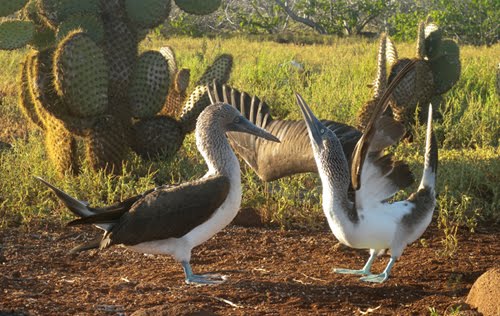
Sunday morning we rise early next to North Seymour for one last walk. As the sun rises we pull up to a set of steps leading to a rocky plateau somewhat like that of Genovesa, this time dominated by Magnificent frigatebirds exhibiting aforementioned behavior. As we walk along the path we encounter yellow land iguanas, scales aglow in the morning light, basking on rocks and clambering through shrubbery as they graze. Soon we come to an expanse of terrain dominated by blue-footed boobies and, I swear to God, they’re just like humans. They court each other, engaging in the infamous Booby Dance, stepping in unison, presenting each other with twigs, and raising wings to each other as they trumpet. Males give trail and court the same females. They sneak up on each other, attempting to separate those who have already exchanged declarations of steadfast love and devotion. They defend their females, chasing and screeching at each other. And established pairs stand side by side, content to watch the drama unfolding around them.
Once we return to the boat it’s quick jaunt back to Santa Cruz, where we transfer to a speedboat that takes us back to San Cristóbal in the company of albatrosses and dolphins.
 The last two weeks have been crazy calm. The weather’s getting a slight bit cooler as the transition to the cool season begins, courtesy of the Humboldt current making itself known– we get some breezes and cloud cover during the day. On occasion it gets a little chilly at night; I wore a sweatshirt for the first time in three months. The water is frigid. I’ve picked up a slight phobia of swimming in it, since people have had weird sores and armpit infections popping up: most likely courtesy of the town’s sewage dump site’s alarming location between the most popular beaches, surf and snorkel sites. The town’s nonfunctional hospital is currently overwhelmed with Dengue Fever, to which only one of us (the students) has managed to fall victim. So far. I’m doing independent study for a professor rather than sit in a stagnant 80° classroom through the mornings. Instead, I get to chill out watching lobos four hours a day. Evenings have included a lot of fire spinning on the beach and the fishing pier, resulting in a rather large quantity of singed arm hair and eyebrows as I take advantage of the opportunity to pick up some new tricks from a friend much more badass than myself. I know, life is hard.